




Hospital Elevator
Manufacturers in Delhi
Hospitals require specialized elevators designed for the urgent and safe transportation of patients, often accompanied by life support systems, medical staff, and essential equipment. To ensure seamless patient care, hospital elevators must accommodate stretchers, wheelchairs, and other critical medical apparatus, with some models even capable of transporting multiple patients simultaneously.
Key Features of Hospital Elevators
✔ Spacious & Hygienic Design – Maximum space is essential for easy movement. Hospital elevators are built with bacteria-repellent, easy-to-clean materials, ensuring high hygiene standards.
✔ Faster & More Efficient – Designed to be quicker than traditional elevators, reducing waiting times and improving patient flow throughout the hospital.
✔ Smooth & Silent Operation – Engineered for minimal noise and vibration, creating a calm and comfortable environment for patients and medical staff.
✔ Emergency Power Backup – Equipped with a backup power system to function seamlessly during power outages or emergencies.
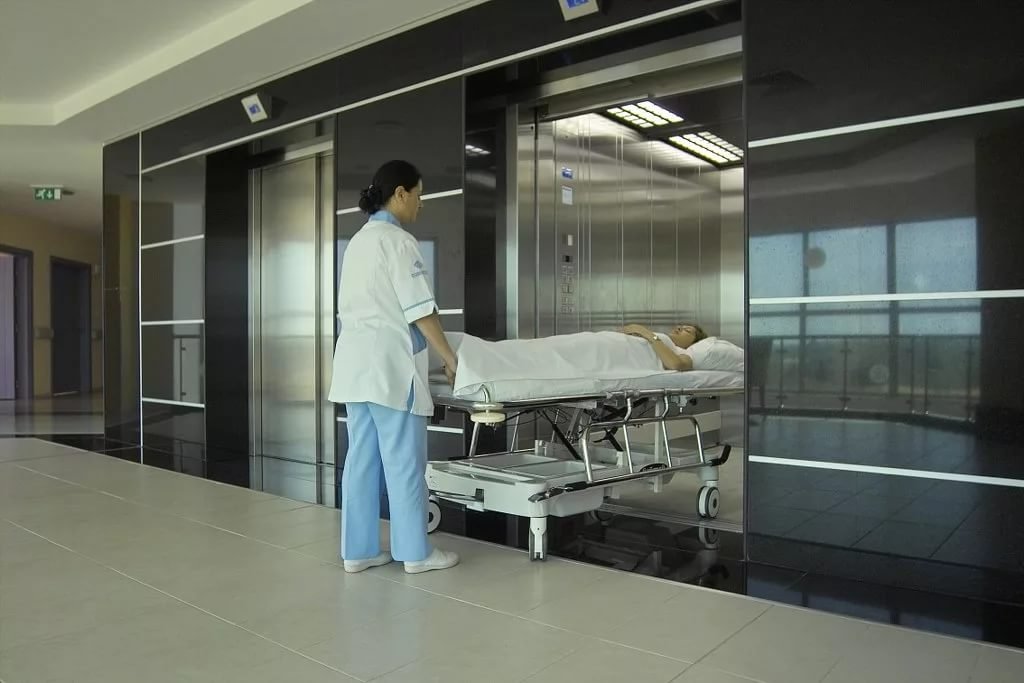
Hospital-Specific Specifications
Unlike standard elevators, hospital elevators are larger to accommodate medical needs. An ideal hospital elevator should be 48 inches wide, 80 inches deep, and 80 inches high, though dimensions may vary based on hospital requirements.
With these essential features, hospital elevators play a vital role in ensuring safe, efficient, and comfortable patient transportation, making them a critical component of modern healthcare infrastructure.
Hospital Elevators: Enhancing Patient Mobility with Safety & Efficiency
Hospitals require specialized elevators to ensure the quick, smooth, and safe transport of patients, medical staff, and life-support systems. Unlike standard elevators, hospital elevators are designed with larger cabins, wider doors, and advanced safety features to accommodate stretchers, wheelchairs, and essential medical equipment.
Key Features of Hospital Elevators
✔ Spacious Cabin & Wide Doors
- Some hospitals require larger cabins to accommodate oversized stretchers or specialized medical equipment.
- The minimum door width for a hospital elevator is 36 inches, though wider doors may be necessary for seamless entry and exit.
✔ High-Speed Performance
- Standard hospital elevators operate at 1 m/s to ensure faster patient transportation.
- Some hospitals may require higher-speed elevators for critical areas like operating rooms or emergency units.
✔ Advanced Controls & Accessibility
- Operated via push buttons or key fobs for easy use.
- Some hospitals incorporate voice-activated controls, ensuring accessibility for patients unable to use traditional buttons.
✔ Safety & Reliability Features
- Emergency Override System – Ensures continued operation during power outages or emergencies.
- Automatic Leveling – Keeps the elevator platform perfectly aligned with the floor for safe and smooth patient transfers.
- Overload Protection – Prevents operation if the elevator exceeds its weight capacity.
Maintenance & Longevity
Like all elevators, hospital lifts require regular maintenance to ensure optimal performance and safety. Routine servicing includes:
✅ Inspection & Lubrication of mechanical components
✅ Electrical system checks to prevent malfunctions
✅ Prompt repairs to ensure smooth operation
V.K. Elevators: Leading the Way in Hospital Elevator Solutions
V.K Elevators is a trusted name in hospital elevator manufacturing, offering best-in-class maintenance, impeccable customer satisfaction, and cutting-edge technology. Our hospital lifts are engineered for smooth, silent, and shock-free operation, allowing patients to be transported without disrupting their life support systems.
For hospitals seeking reliable, high-performance elevators, V.K Elevators provides customized solutions that enhance efficiency, safety, and patient comfort.